
DE / ENRequest a part →
NFK Wetpreg Molding combines controlled layup, defined impregnation and industrial forming into a new manufacturing path for natural fiber composite parts.
Natural fiber composite unfolds its strength when fiber, resin, tooling and part are consistently thought through together.
Natural-fiber textiles with different properties are combined deliberately — instead of random fiber distribution.
Digitally recorded, automated process parameters ensure consistent quality across the entire series.
A reusable, temperature-controlled vacuum hood applies the consolidation pressure — short cycle time, homogeneous wall thickness.
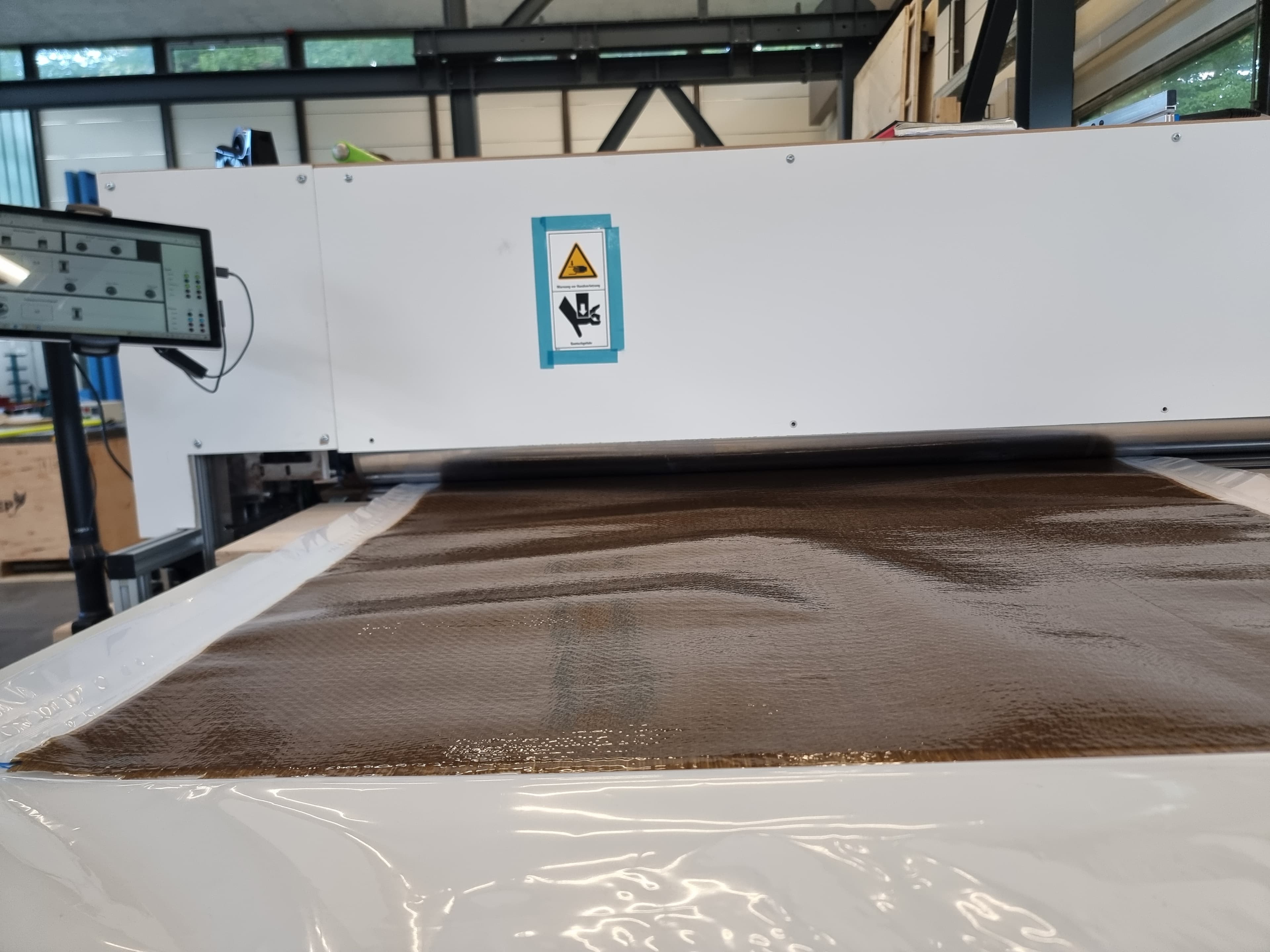
In NFK Wetpreg Molding, natural-fiber plies are impregnated in a defined, semi-automated way and then consolidated and cured in the tool with a reusable, temperature-controlled silicone vacuum hood. The result is a process that depends less on manual wet processing — with reproducible part quality.
Tailored textiles from hemp, flax & co., cut to fit.
Defined, semi-automated impregnation of the cut pieces (Wetpreg).
Controlled ply and sandwich layup in the tool.
Reusable vacuum hood, short cycle time, consistent quality.
Trimming, finish, assembly — ready-to-fit component.
NFK Wetpreg Molding isn't better in every case — but specifically where classic processes don't fit ideally for large-area natural-fiber parts in series.
Fiber mats are manually soaked with resin and placed in an open mold.
Highly dependent on manual work: fluctuating quality and fiber volume content, long cycle times, open processing.
A defined, pre-impregnated layup instead of manual wet lamination — reproducible and series-ready.
Chopped fibers are sprayed onto the mold together with resin.
Random fiber orientation and lower structural quality; high scrap.
Purposefully designed natural-fiber plies instead of random fiber distribution.
Dry fibers in a closed vacuum setup, resin is infused under vacuum.
Process-sensitive (flow paths), lots of single-use consumables, long setup and process times.
Defined pre-impregnation + a reusable vacuum hood: less single-use, shorter cycle time, less process risk.
Dry preform in a closed two-shell tool, resin is injected.
High tooling & equipment cost; pays off only at higher volumes.
Comparable process control with lower tooling effort — one mold + a temperature-controlled vacuum hood.
Pre-impregnated fibers are draped and cured under temperature and pressure.
Expensive, cold storage and limited pot life, energy- and capital-intensive (autoclave).
Controlled layup like prepreg — without cold chain, high-end cost and autoclave.
Natural fibre as a material is not new. What is new is processing it so that series components become economically viable. That is exactly where our protected technology sits.
The reason natural-fibre composite rarely reaches series production is seldom the material. It is the processing: natural fibres behave differently from glass fibre when cut, impregnated and draped. Processing them with methods developed for glass fibre yields fluctuating quality and long manual process times — and therefore part costs that eat up the material advantage.
Fibryx therefore starts not with the material but with its processing. Impregnation and cutting are the two steps that decide economic viability with natural fibre — and both are covered by our own patented technology.
Classic hand lamination soaks the fibre in the mould itself — with all the variation manual wet work brings. We impregnate the cut pieces beforehand, semi-automatically on a conveyor line, with a defined resin application. The result is a reproducible fibre volume content rather than a value based on experience.
On large-area parts with double-curved geometry, the cut decides waste, drapability and placement time. Our algorithm calculates cutting patterns and patches specifically for the behaviour of natural-fibre textiles. On a front skirt for a harvester this reduced manual process time by around 30 percent.
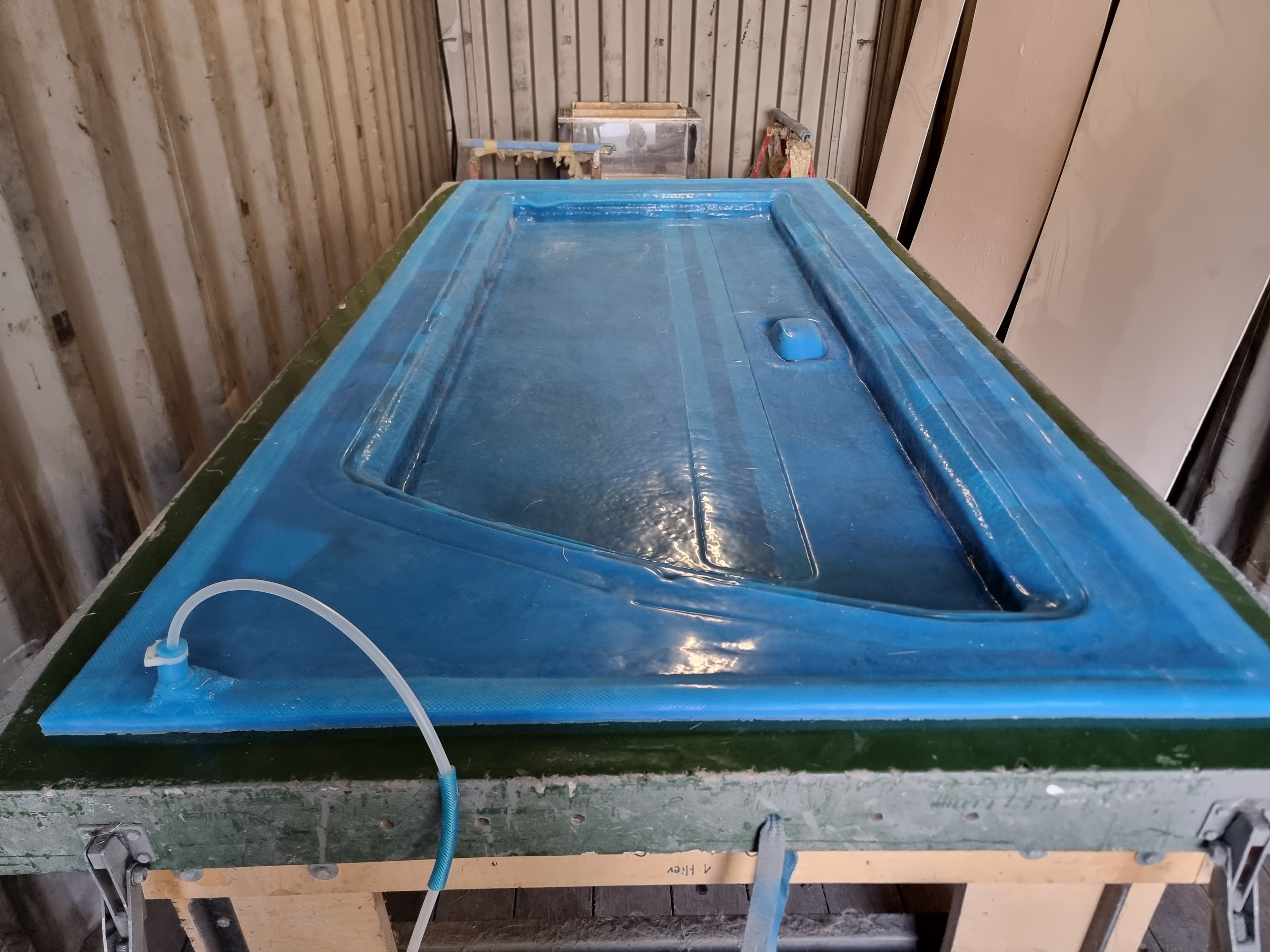
RTM needs two mould halves and therefore high tooling costs that only pay off at large volumes. We consolidate with a reusable, temperature-controlled silicone vacuum hood against a single mould. That markedly lowers tooling cost per part — the reason small and medium series become economically viable.
The processes for processing and impregnating natural fibres are covered by our own intellectual property rights. For projects where the IP situation is relevant — supplier approvals or due diligence, for example — we provide the documentation on request.
Every process has its window. This classification shows where wetpreg moulding fits — and where another process remains the better choice.
| Process | Tooling | Volume window | Reproducibility |
|---|---|---|---|
| Hand lamination | One mould, low cost | One-offs to small series | Strongly operator-dependent |
| Vacuum infusion | One mould plus set-up | Small to medium series | Good, but long cycle time |
| RTM | Two mould halves, high cost | Medium to large series upward | Very good, short cycles |
| Autoclave prepreg | Mould plus autoclave | Small series, high grade | Very good, costly, chilled storage |
| NFRP wetpreg moulding | One mould plus reusable vacuum hood | Small to medium series | Good to very good, short cycle time |
At very high volumes RTM remains economically superior. Our window is small and medium series with large-area parts — precisely the range in which commercial-vehicle, caravan, agricultural and construction machinery construction actually operate.
What value can we create with NFRP for your part? We assess it together — step by step.
Assess the potential for weight, cost and properties — NFRP vs. GFRP.
CAD, load cases, material & layup, tooling concept.
Sample parts, demonstrators, material and part testing.
Process window, quality assurance, finish & assembly — up to ~5,000 units/year.

What value can we create with NFRP for your part? Let's assess the potential together.
Request a part →