
Industries
Technology
Projects
Company
Request a part
DE / EN
Industries

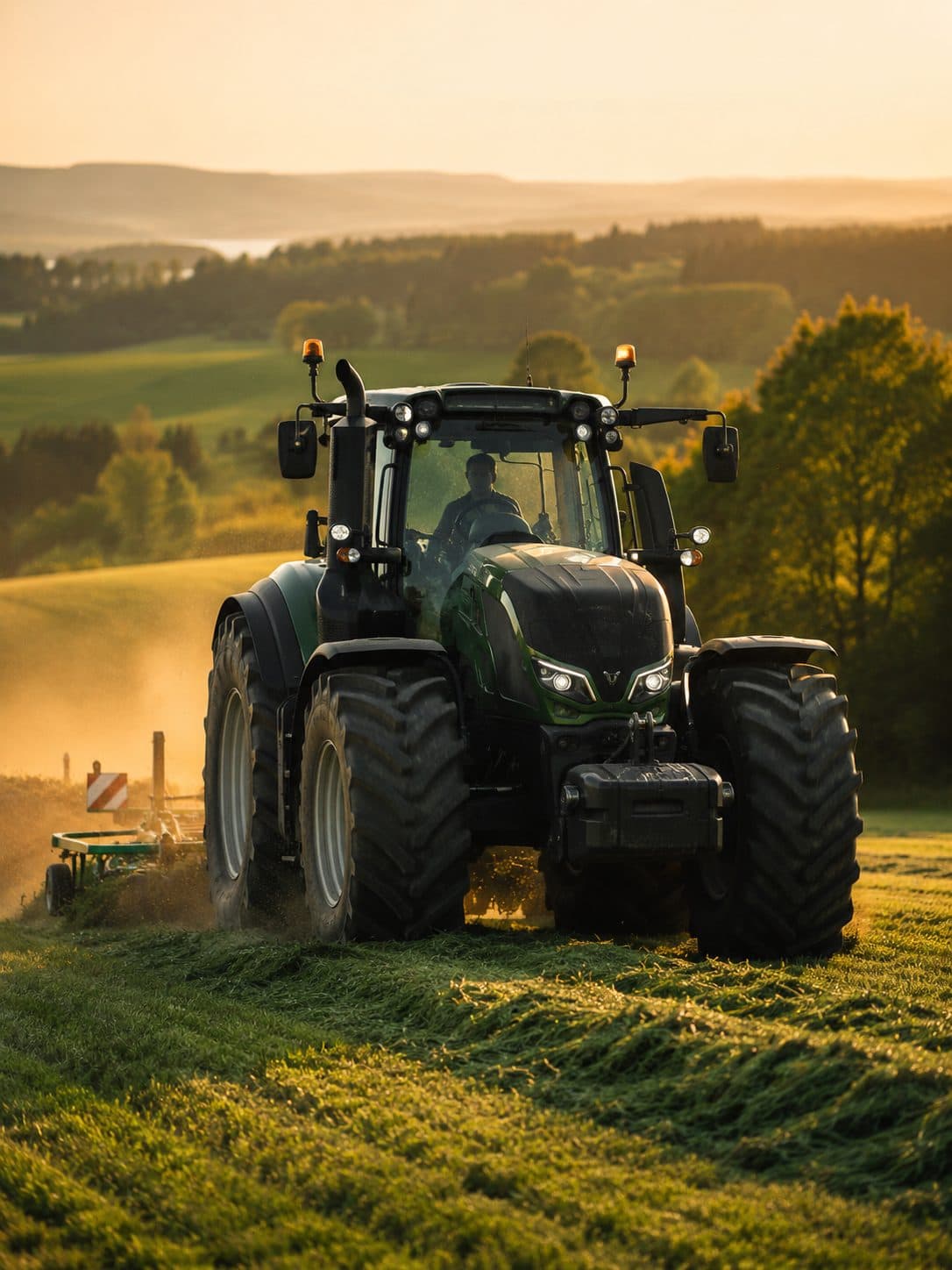
Lightweight components for agricultural machinery.

Front skirts, hoods and cladding — robust, weather-resistant components with reduced weight and efficient manufacturing.
Challenge

What really counts in Agricultural Machinery parts.

Today every part has to meet several goals at once — that is exactly where natural fiber composite comes in.

Components & applications

What we manufacture for Agricultural Machinery.

Front skirts

Large visible parts — light and made with an optimized cut.

Engine hoods

Light, impact-resistant, with a defined surface.

Side cladding

Weatherproof and dimensionally stable.

Covers & flaps

Functional parts incl. fastening.

Cabin parts

Light interior and exterior components.

Robust cladding, efficiently manufactured.

Benefit

Lighter — and more economical.

NFRP reduces not only weight but directly the part cost — with properties comparable to GFRP.

−15%
Part cost
−30%
Weight
−90%
CO₂

Why NFRP lowers the part cost

Less weight = less material

Lower density and an optimized layup reduce material usage per part — directly cost-effective.

High automation

Semi-automated impregnation and digitally defined processes reduce manual work and manufacturing cost.

Manufacturing efficiency

Short cycle time through the reusable vacuum hood and ready-to-fit delivery save follow-up costs.

Why natural fibre fits here

When the bottleneck is not the material but the cutting

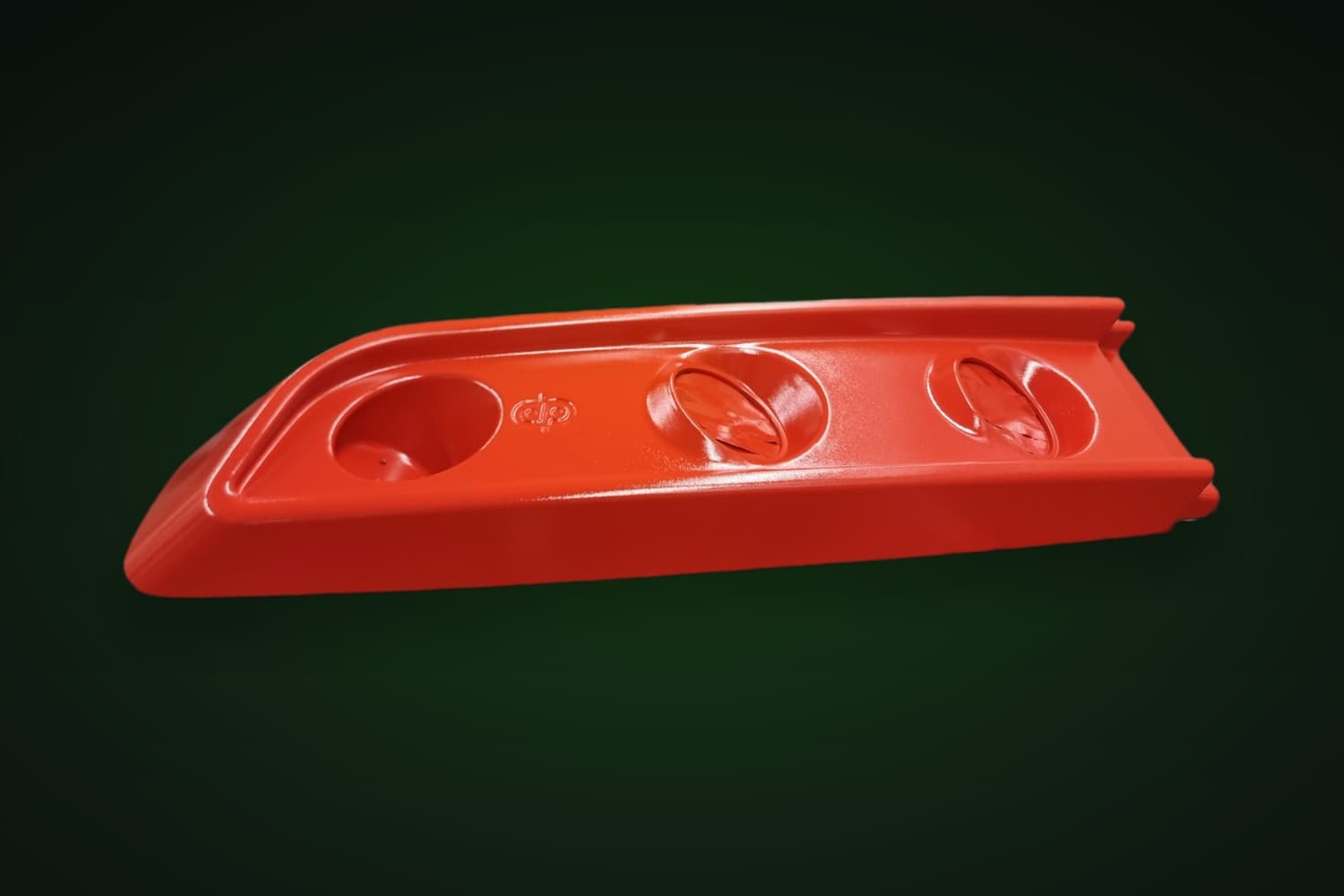
Cladding parts on agricultural machinery are large, geometrically complex and produced in manageable numbers. On such parts a substantial share of production time goes not into forming but into cutting and precisely placing the reinforcement — a manual step that is at the same time the main source of quality variation.

That is exactly where the Fibryx algorithm applies: it optimises cutting patterns and patches for natural fibre, so that less waste arises and placement becomes faster and more repeatable. Combined with semi-automated impregnation on a conveyor, manual process time on a large-area front skirt was reduced by around 30 percent. The lever here was the process, not the material.
In practice

Already realised — with measurable results.

Front skirt, harvester
Agricultural machinery

Front skirt, harvester

−30%
manual process time
  • Optimized cutting patterns & patches (Fibryx algorithm)
  • Semi-automated impregnation via conveyor
  • Reproducible, high quality at shorter process time

From a single source

Concept, material, tooling, manufacturing and assembly with one partner — fewer interfaces, less risk.

Reproducible series

Digitally recorded process parameters ensure consistent part quality — up to ~5,000 units / year.

Our own technology

Patented NFK Wetpreg Molding and in-house material design as a real differentiator.

Trusted by leading OEMs & industrial companies
Daimler Truck
Traton
VDL
Carthago
Depoortere
CF Maier
Vöhringer
Radkutsche
EPAtec
How we work

From the part concept to the ready-to-fit series.

One continuous path — series-ready and reproducible.

01

Part concept & package

Requirements, packaging, interfaces — thought through from the first concept.

02

Load cases & engineering

Stiffness, temperature, vibration, weather and fastening points.

03

Material & layup

Natural-fiber plies, resin system, sandwich layup, local reinforcements.

04

Prototypes & sampling

Sample parts, demonstrators, fit trials, iteration on the real part.

05

Tooling & manufacturing

Prototype and series tooling, process window, trimming, quality assurance.

06

Finish & assembly

Gelcoat, painting, inserts, fastening points, ready-to-fit delivery.

The easy entry point

Start with an NFRP concept study.

You don't have to commit right away: send us an existing GFRP part, a drawing or an idea. We assess the potential — and you see whether the path is worth it.

  • Potential assessment: weight, cost and properties
  • Direct comparison NFRP vs. your current GFRP part
  • A concrete assessment on the real part — no theory
  • A clear recommendation for the next steps
Request a concept study
Frequently asked

Questions from this sector

Do the parts withstand field use?
Weather, UV and chemical resistance are set through additives in the resin system. Natural-fibre composite is also impact-resistant and breaks into sharp splinters less readily than glass fibre — a practical advantage in rough use.
What exactly does the Fibryx algorithm do?
It calculates cutting patterns and patches for natural-fibre reinforcements so that waste falls and placement in the mould becomes faster and more repeatable. On large-area parts with complex geometry this is the biggest time factor.
How reproducible is the quality?
The combination of optimised cutting and semi-automated impregnation reduces precisely those steps where manual production creates scatter. The result is more consistent part quality at shorter process time.
Can existing parts be replaced one to one?
Not without assessment. A natural-fibre part is designed in its own right: layer build-up and reinforcements follow the specific load case. In the concept study we assess from a drawing or sample what is possible.

Let's talk about your component.

Send us a drawing, an existing GFRP part or an idea — we'll get in touch and assess the potential for natural fiber composite together.

Request a part

Related